The Role of Marketing in Mergers & Acquisitions (The Tale of the Twinkie)
In 2012, Twinkie fans taught us an important lesson about marketing: When it comes to company valuation, customer loyalty is king.
Allow me to put some words in front of you.
This question dates all the way back to 1941, when it was posed in an issue of Public Opinion Quarterly. A full three-quarters of Americans (75%) responded no, anti-democracy speeches should not be allowed.
But that wasn’t the only question the article posed. In fact, they did what’s called a split-ballot experiment – where one half of a randomly-selected sample received that question, and the other half received this one:
Did you have to read it twice? That’s because at face value, these questions seem almost identical. In fact, they only differ by six letters: one asks whether speeches should be "allowed," and the other asks whether they should be "forbidden." Functionally, they communicate the same thing from two different angles – so it should follow that the results would be analogous.
But in fact, while 75% of Americans would "not allow" speeches against democracy, only 54% would "forbid" them.
It's easy to hypothesize why this could be, but semantics isn't the point. The point is, a six-letter difference completely altered perception of the question - and by extension, the survey results. The experiment became part of survey lore, illustrating that small changes in wording can have massive (and sometimes unintended) consequences.
The average American consumes no fewer than 100,000 words each day. (For context, War & Peace is 560,000 words.)
And those words are more than just a means of communication. Research has shown that words don’t just reflect our thoughts... they can actually shape them.

A study out of UCSD came to this conclusion after showing the same video to two groups of people. In the video, a man in a museum bends down to take a picture and accidentally knocks over a vase behind him. The only difference between the two groups was the video's caption: In one group, it was accompanied by the words “he broke the vase.” In another, a more neutral “the vase broke.”
Not only was the first group more likely to blame the man for the incident, they levied 53% more in fines as punishment – even when both groups witnessed an identical event. This proves that language not only guides our reasoning, but even how we perceive the world around us.
This makes sense, since the difference between “allow” and “forbid” was enough for 21% of Americans to completely shift their stance on democracy and free speech.
But the significance of words goes far beyond just academic intrigue.
If you’re a business leader, words are probably a big part of your role. But, let’s be honest, you probably use a lot of them on autopilot. The words you choose have tremendous power – and can significantly impact your work, your relationships, and people’s perception of you.
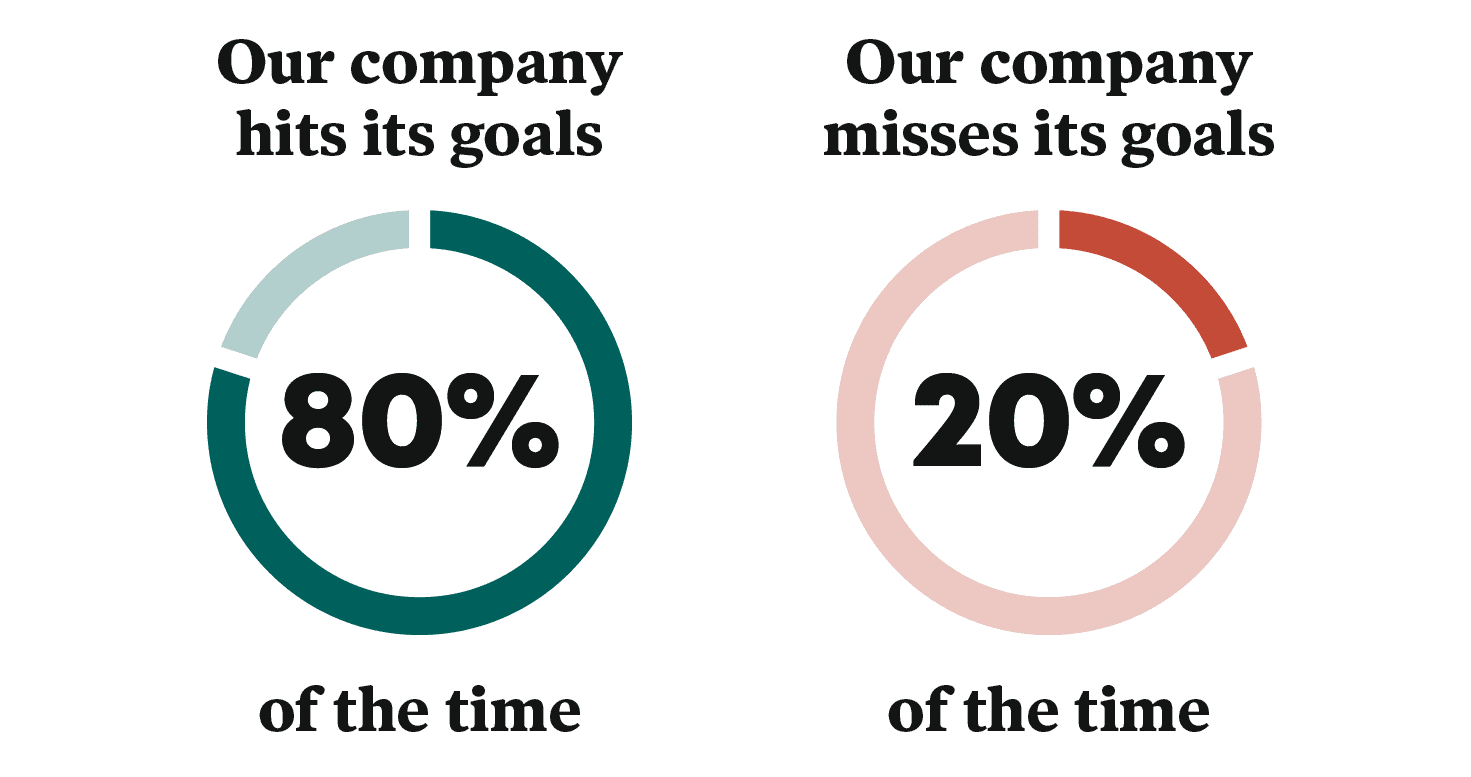
If you tell your team that the company hit its goals 80% of the time as opposed to missing them 20% of the time, you’re ultimately communicating the same thing. But what people hear from those two communications is very different: People perceive the former to be much more positive than the latter.
This becomes particularly important when you consider the language of the professional world – which determines where dollars are spent, what policies are enacted, and what working environment you create.
What six-letter difference could be impacting your business in ways you haven’t even considered?
There are tangible changes you can make to completely flip the script in your communication. Changes like:
Likewise, your internal communication can make the difference between an engaged company culture and a disjointed bunch of unhappy employees. Think about:
Whether you’re drafting a survey question about public speaking, or assigning blame and punishment for a broken vase, or – most importantly – interacting with the people who make your business what it is, remember that you never know what an impact even six letters could make.
This article represents less than 2% of the words you’ll interact with today. What will you do with the other 98%?
Kinesis works with business leaders to reimagine their culture and internal communications. Think your organization might be a fit? Give us a call.



In 2012, Twinkie fans taught us an important lesson about marketing: When it comes to company valuation, customer loyalty is king.

Having a large customer the size of an 800-pound gorilla drives rapid revenue growth, but it also carries hidden dangers for your business.
Learn how to tame it.
Get insights like this straight to your inbox.